
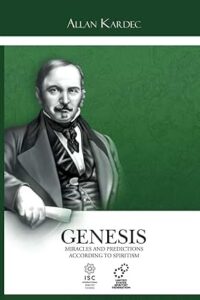
Genesis: Miracles and Predictions According to Spiritism
by Allan Kardec
Synopsis
This is the last of the five books of the Spiritist Codification, published in 1868. It provides a scientific perspective to the Spiritist Doctrine whose foundations are evenly distributed among religion, philosophy, and science. Written with the scientific knowledge available to Allan Kardec during the mid-XIX century, this is perhaps one of the most difficult books of the Spiritist Codification in that it shows the reader how important it is for religion and philosophy to be associated with scientific knowledge. With his inimitable pedagogical style, Allan Kardec divides the book into three main parts: the first explains the spiritist views on the creation and related dogmas as it explores in great detail such subjects as God, the ideas of good and evil, human evolution, cosmology (uranography), and the earth sciences as understood in 1868. The second part deals with the dogma of miracles, and the book presents more rational and scientific explanations to these phenomena, be it to their origins or the teachings involved therein. It is a solid approach towards dispelling the idea of the supernatural in any aspect of earthly life and an invitation altogether for all to study and elucidate what at first may appear as a transgression of the natural or universal laws. In the same vein, the third part deals with the concept of future predictions, alluding to the fact that such phenomena are basic impossibilities and that Christian biblical predictions of the future, whether apocalyptic or not, should not be understood through the light of science. This book is one of the five basic works that make up the Codification of Spiritism, and it is the author’s most scientific work. It deals with themes regarded as incontestable by religion in the light of the immortality of the soul, unifying Christian thought and scientific discoveries. It offers a unique opportunity for the reader to know and study themes of universal interest, discussed in a logical, rational and revealing manner. The book is divided into three parts: the first part analyses the origin of planet Earth and avoids the mysterious or magical interpretations about its creation; the second part addresses the question of miracles, explaining the nature of fluids and the extraordinary phenomena contained in the Gospel; and the third part focuses on the prophecies in the Gospel, the signs of the times and the new generation, whose advent will be the beginning of a new era for humankind based on the practice of justice, peace and fraternity.